Sweep graphic

Beef Fertility and Production.

Reproductive management of beef cattle is strongly related to net return.

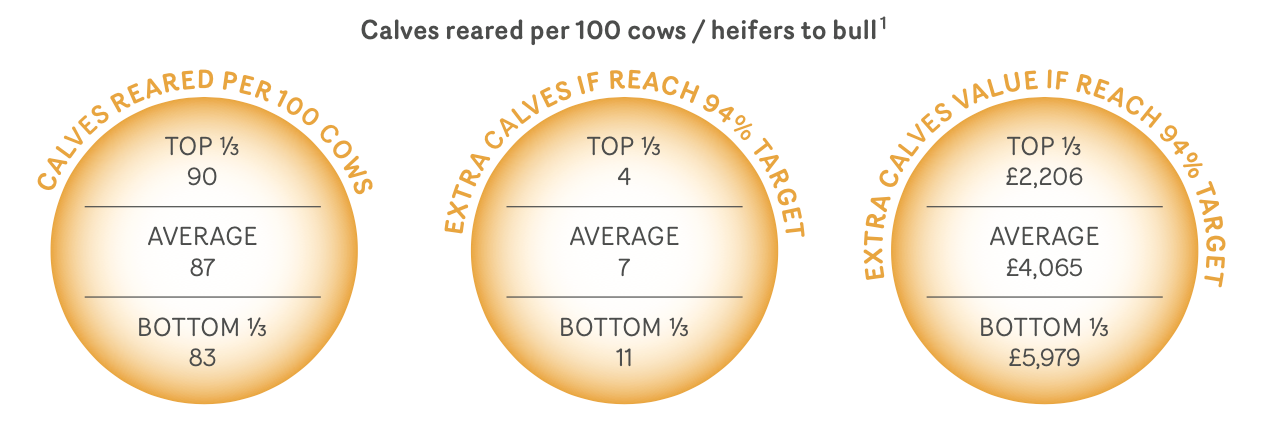
Fertility efficiency of a beef suckler herd is defined by achieving the maximum output (kg) of saleable beef / breeding cow / year and is commonly measured by calf crop % (number of calves weaned / number of cows mated x 100), the target being >94%.

Beef cows
Beef fertility chart

Assumption - Calf value of £550 at weaning, based on weight of 275kg and price of £2.00/kg.

Calving Interval

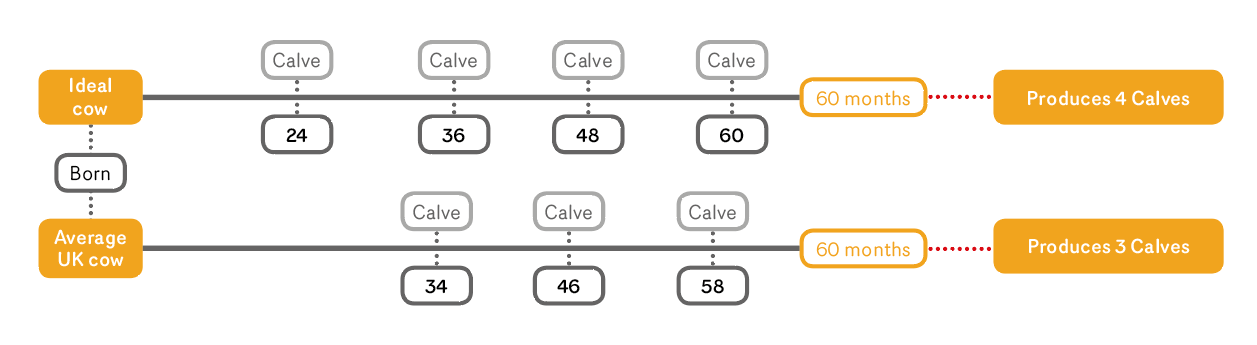
The average calving interval in the UK is just over 426 days2. An increase of the calving interval from 12 to 14 months will numerically decrease the calf crop by 16%, meaning that a 50-cow herd with a calf crop of 94% producing 47 calves annually in the ideal situation, will only produce 39 if the calving interval extends to 14 months.
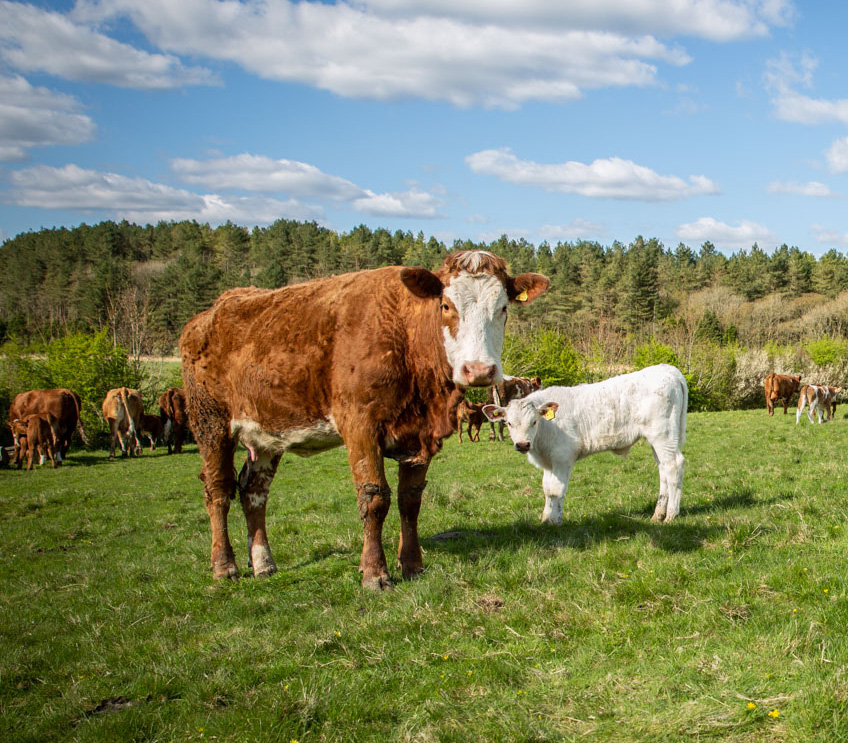
Beef cows
x

Age at first calving also has a huge impact on beef herd output: more calvings in the same period of time increases net return.

Compact Calving Periods

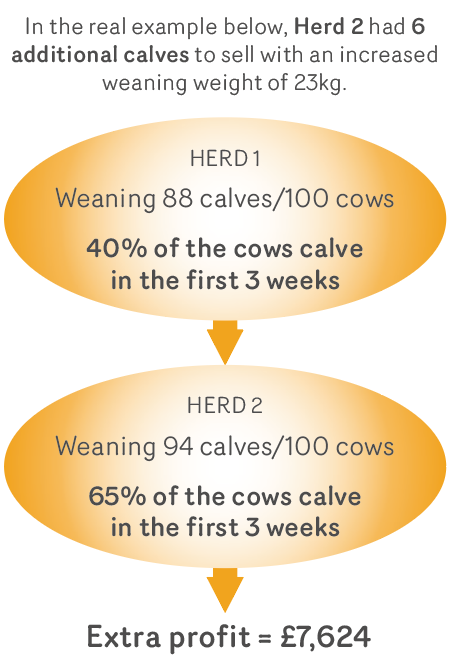
The advantages of having a more compact calving period include:
  • Cows have longer to recover before going back to the bull or being presented for fixed time AI (FTAI)
  • Improved calf weaning weights
  • Reduced disease risk in younger calves
  • Reduced additional extra labour requirements
  • Ability to more intensely manage the calving period
x

Chart showing how a reduced calving interval and compact calving period can have a significant impact on profitability.
Assumption - Calf value of £550 at weaning, based on weight of 275kg and price of £2.00/kg.

Synchronisation and benchmarking fertility performance


The benefits of using synchronisation protocols include:
  • Less time spent on oestrus detection – target AI based on protocol timings rather than heat detection
  • Ability to re-establish cyclicity in anoestrus cows and reduce cull rates
  • Optimised farm organisation: pregnancy check, calving period, optimal utilisation of resources, food resources
  • Even batches of calves with the potential for decreased neonatal mortality, disease prevention planning and higher liveweight gain
  • The ability to accelerate genetic gain (e.g. ease of calving, muscle mass)
  • The ability to use sexed semen to increase the number of male calves from cows and female replacements from heifers
x

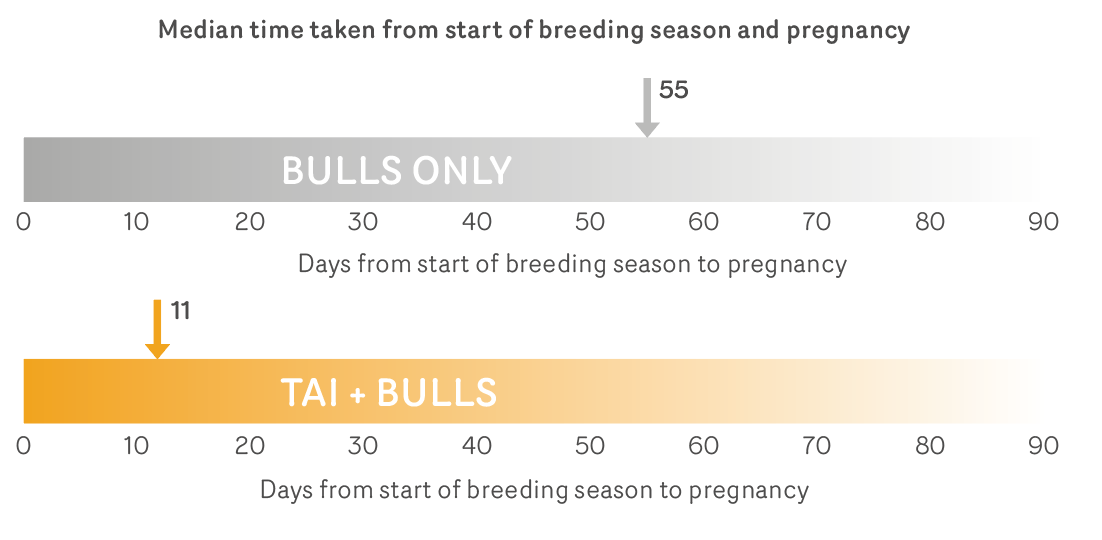
Chart showing the median time taken from the start of breeding season to pregnancy using the bull only or a combination of FTAI and bull.

Improving heifer management will not only reduce the age at first calving but will also dramatically improve the reproductive performance of these future cows3:
  • Heifers calving in the first 21 days of their first year had increased longevity to heifers calving in the second 21-day period: 5.1 vs 3.9 years
  • Heifers calving in the first 21 days of their first breeding season had higher weaning weights every year for 6 calves
Image dairy cow and calf

Progesterone and Beef Cyclicity

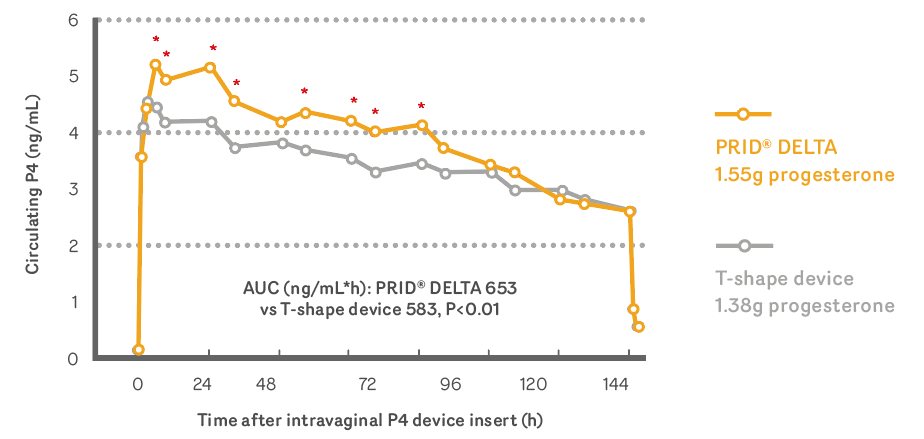
Studies have shown that the use of progesterone devices in beef heifers and cows improved cyclicity, increased the expression of heat and pregnancy rates after AI, assuming a good body condition score and reproductive tract health4.

PRID® Delta is the progesterone releasing intravaginal device with the most progesterone available on the U.K. market.
x

Ask your vet about which synchronisation protocols are best suited to your beef herd.

PRID<sup>®</sup> Delta pack

References:

  1. Cattle and Sheep Enterprise Profitability in Scotland – 2009, 2010 and 2011. Aggregated data for non LFA, LFA selling weaned calves and LFA selling yearling calves.
  2. British Cattle Movement Service (BCMS) report 2019 https://www.gov.uk/government/organisations/british-cattle-movement-service
  3. R A Cushman, L K Kill, R N Funston, E M Mousel, G A Perry. Heifer calving date positively influences calf weaning weights through six parturitions J Anim Sci. 2013 Sep;91(9):4486-91. doi: 10.2527/jas.2013-6465
  4. R K Kasimanickam, V R Kasimanickam, J Oldham, M Whitmore. Cyclicity, estrus expression and pregnancy rates in beef heifers with different reproductive tract scores following progesterone supplementation Theriogenology. 2020 Mar 15;145:39-47 doi: 10.1016/j.theriogenology.2020.01.028. Epub 2020 Jan 15